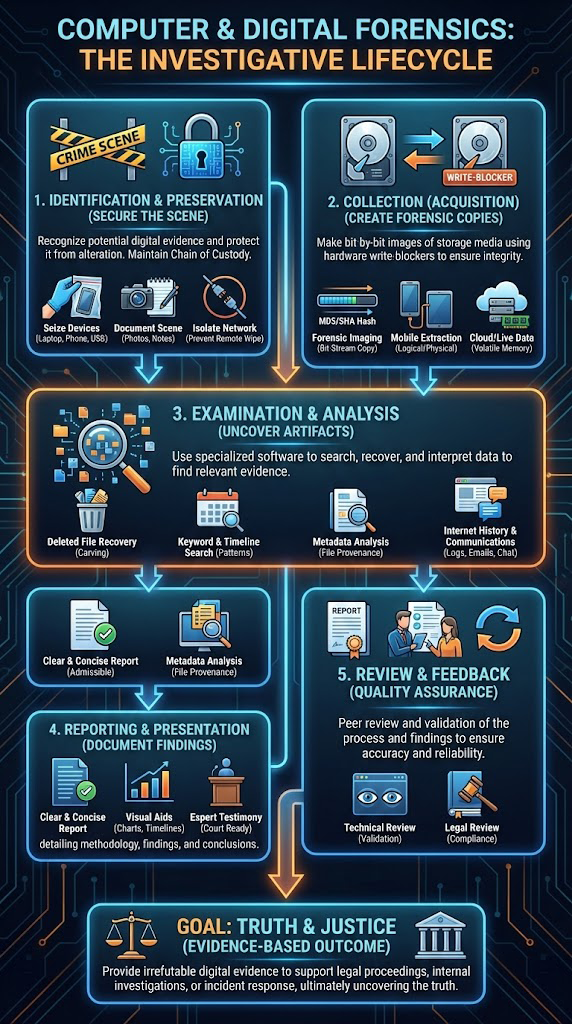
Digital forensics is the process of collecting, preserving, analyzing, and presenting digital evidence for legal, internal, or investigative purposes. It's widely used in civil and criminal cases, corporate investigations, and incident response.
1. Identification & Preservation (Secure the Scene)
The first priority is to recognize potential digital evidence and protect it from alteration.
Typical steps:
- Seize devices – laptops, desktops, servers, phones, USB drives, SD cards, cloud accounts
- Document the scene – photographs, notes, and logs describing where and how devices were found
- Isolate networks – disconnect systems from the internet or internal networks to prevent tampering
- Maintain chain of custody – carefully track who handles evidence and when
2. Collection (Acquisition)
The goal is to acquire forensic copies without changing the original data.
- Forensic imaging – bit-by-bit copies of drives using hardware write-blockers
- Mobile device extraction – logical or physical capture of phone data
- Cloud and live data – capturing volatile data (RAM, live logs, active sessions) when appropriate
- Hashing (MD5/SHA) – creating cryptographic hashes to prove integrity of collected images
3. Examination & Analysis (Uncover Artifacts)
Specialized tools and methods are used to sift through collected data:
- Deleted file recovery (carving)
- Keyword and timeline analysis
- Metadata analysis for file provenance and user activity
- Internet history and communication analysis (logs, emails, chats, social media)
- Malware and intrusion analysis in security cases
The objective is to find relevant artifacts, reconstruct events, and answer specific investigative questions.
4. Reporting & Presentation (Document Findings)
Findings must be:
- Clear and concise – understandable to non-technical audiences (judges, juries, executives)
- Well-documented – including methodology, tools used, limitations, and results
- Visual when helpful – charts, timelines, or screenshots can clarify complex activity
- Admissible – procedures must align with legal and industry standards
5. Review & Feedback (Quality Assurance)
To ensure reliability:
- Another examiner may perform a technical review of the process and findings
- Legal teams may conduct a legal review to ensure compliance and relevance
- Feedback is used to refine methods and improve future investigations
Goal: Truth & Justice
Done correctly, digital forensics provides strong, evidence-based support for:
Court cases and litigation
Internal HR or compliance investigations
Security incident response
Regulatory inquiries
Professional Forensic Services
Denver Data Recovery offers forensic imaging, analysis, and expert services to law firms, corporations, and government agencies.
To discuss a potential forensic matter, request a free quote online at denverdatarecovery.net or call 720-222-0110.